
-
Created by
 Christel Prudhomme, last updated on Aug 27, 2025
5 minute read
Christel Prudhomme, last updated on Aug 27, 2025
5 minute read

Overview
Reforecasts (also sometimes called hindcasts) are sets of past forecasts that are computed retrospectively using the same (or as close as possible) model as the real-time forecast for a number of past dates. In CEMS-Flood, the hydrological reforecasts are generated for medium, extended and seasonal ranges using the same hydrological modelling chain as for the operational forecasts and reanalysis datasets.
Compared with operational forecasts, reforecasts have two main advantages:
- they span a much longer time period (usually 20+ years), hence can better describe the interannual variability and contain larger sample of possible realisations useful to derive robust statistics
- they are generated retrospectively, using the same (or as close as possible) NWP model as the real-time forecast, hence containing the latest model development representative of the operational model
Hydrological reforecasts can be used for two main activities:
- to evaluate the skill of the forecast system, by comparing observations (or proxi observations such as the reanalysis) with reforecasts for a set of past dates as long as possible
- to define climatological statistics consistent with the forecasts (with varying lead times), which may have different biases than the historical simulations run with reanalysis or observation forcing.
The CEMS-Flood reforecast configuration
CEMS-Flood reforecasts are produced using reforecasts from ECMWF ENS medium-range and seasonal range systems as meteorological forcing.
Medium to extended range
ECMWF-ENS medium and extended range reforecasts are currently generated on fixed days of the month, about every 4 days (1, 5, 9, 13, 17, 21, 25, 29, except 29 Feb), for the same date in the past 20 years with 11 ensemble members out to a lead time of 46 days. From EFAS v5 and GloFAS v4, the meteorological forcing for the hydrological reforecsts is available in two flavours, a high-resolution version on 9-km out to 15 days, and a lower resolution version at 36-km out to 46 days. The reforecasts then are forced through the CEMS-Flood hydrological modelling chain to produce 20 years of river discharge reforecasts, for all start dates available, with the 11 ensemble members. For EFAS, the high-resolution meteorological reforecasts are used as forcing out to day 15. For GloFAS, the first 15 days are forced with the high-resolution meteorological reforecasts, while the remaining days 16-46 period is forced with the low-resolution reforecasts. This creates a single, seamless simulation from day 1 to day 46. A schematic of the available ECMWF-ENS-forced reforecasts over the whole January-December period with 2019 reference date (for which the reforecasts were produced still twice a week for Mondays and RThursdays), is given in Figure 1.
For EFAS, the medium-range river discharge reforecasts are run for each river cell at a 6 hr time-step out to a lead time of 46 days with 11-ensemble members each. For GloFAS, the river discharge reforecasts are run for each river cell at a 24 hr time-step out to a lead time of 46 days with 11-ensemble members each.
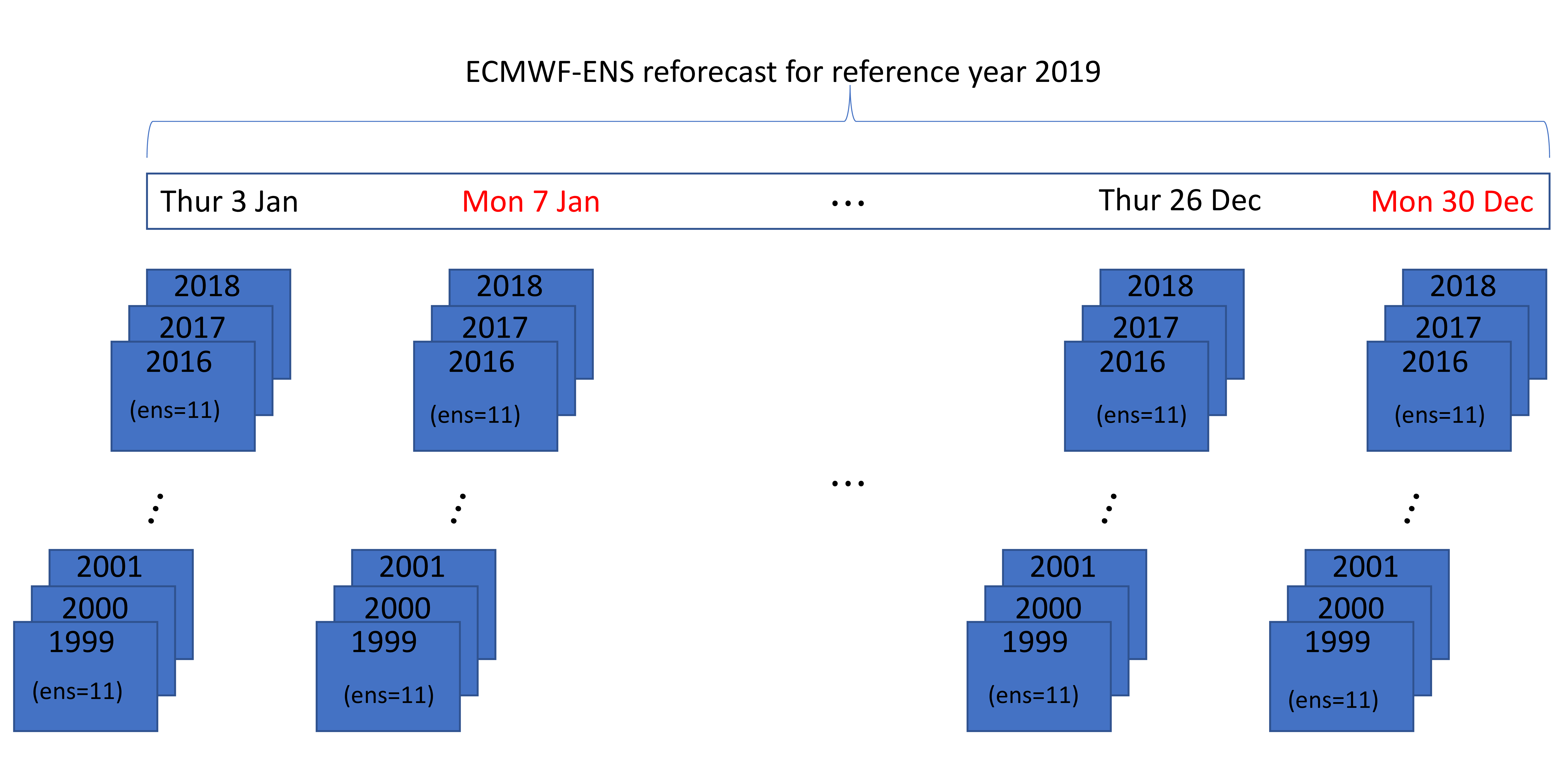
Figure 1: ECMWF-ENS reforecast configuration schematic for the reference period January to December 2019.
The CEMS-Flood medium/extended range reforecasts are produced in a real time fashion, whenever a new meteorological reforecast is generated for the fixed days of the months (provided above), for always the past 20 years. This means, until the main version of EFAS or GloFAS (e.g. v5 for EFAS and v4 for GloFAS) is in use, the reforecast archive is continuously building with a new reforecast set produced about every 4 days.
Consistency between reforecasts and real-time forecasts
Reforecasts produced for the most recent year(s) can potentially be for dates which has also real-time forecasts available for. This happens when a version of EFAS or GloFAS is in use for more than a calendar year. The major difference between the real-time-produced forecasts and reforecasts for the same date is the number of ensemble members, 51 and 11, respectively. Whilst each river discharge simulation of the individual ensemble members do differ, the whole ensembles are expected to provide very similar estimates of the future river discharge scenarios. Other difference in the two simulations is the used river initialisations. As the reforecasts are produced retrospectively, they use the final historical simulations to initialise from, namely ERA5-forced in GloFAS and OBS-forced in EFAS. However, the forecasts produced in real-time manner can not rely on these, as they are not yet available, and a short period of fillup is also included, forced with the shortest range ENS CF forecast, right before the forecast initial time (usually for a day or so). The differences in the meteorological conditions during this short fillup period can occasionally be quite substantial, either as the observations can differ to the shortest range ENS CF forecast (in EFAS), or similarly the ERA5 meteorological simulations can differ to the ENS CF due to different model versions and resolution. However, differences between real-time- and reforecasts are expected to the appear mostly randomly, unless some systematic biases are present in the ENS CF vs either the OBS or ERA5 (i.e. the observations can be underestimated (or overestimated) by the ENS CF in some areas, or similarly ERA5 can show systematically lower or higher precipitation that ENS CF).
Seasonal range
ECMWF SEAS5 reforecasts are generated for the first of each month for the 36-year period of 1981-2016, with 25 ensemble members and lead time of 7 months. These meteorological reforecasts are then forced through the CEMS-Flood Seasonal hydrological modelling chain to produce 36 years of river discharge reforecasts, once per month, with 25 ensemble members and a 213-day lead time. Seasonal forecasts are also produced from January 2017, but those run with 50 ensemble members, the same as the real-time gneration of the seasonal. In all other aspects then the number of ensemble members, the seasonal forecasts before and after Jan 2017 are identical.